The group has just arrived at the Catacombs of San Callisto for a tour of this ancient Christian burial ground. Here are the pilgrims waiting outside for their tour to begin. Mass will follow the tour.
The group has just arrived at the Catacombs of San Callisto for a tour of this ancient Christian burial ground. Here are the pilgrims waiting outside for their tour to begin. Mass will follow the tour.

The pilgrims have just visited the Basilica of St John Lateran, the Cathedral Church of Rome. As the seat of the Pope it is the mother church of the Diocese of Rome and of the world. Lunch is next, followed by a visit to the Catacombs for a tour and Mass.
First stop on this final day in Rome is the Basilica of St Paul, outside the city walls. Here there are mosaics of all 265 Popes, in order. The group is currently having a tour of this fine church, where St Paul himself is buried.
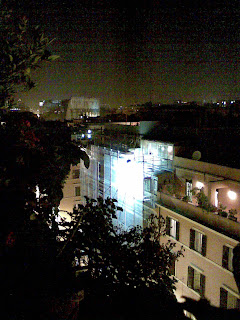
After a free day our Cathedral pilgrims are now returning to the hotel, ready for the evening meal. Those in the group who have visited the hotel's roof terrace can see the view pictured here. Unfortunately this image isn't very good quality, but you can make out the world famous Colosseum in the top left corner. Don't forget that you can enlarge any image on the blog by clicking on it, and we will post some higher quality images after the pilgrimage.
Today our pilgrims have a free day. A number are visiting the Vatican museums and the Sistine Chapel, and no doubt everyone has a place or two they would like to visit. The day started early with Mass in the crypt of St Peter's; here you can see the group walking towards the Basilica first thing this morning.
Before returning to the hotel our pilgrims called in at the church of the Holy Cross, where there are relics of the Passion, brought to Rome by St Helena, mother of the Emperor Constantine. The relics have been a focus for devotion since that time, and the group said prayers together in the relics chapel. A free evening is ahead, followed by an early Mass at St Peter's Basilica tomorrow morning.
After a wonderful day trip to Subiaco the pilgrims are now heading back to Rome. Back in the city there will be a chance to visit the Basilica of the Holy Cross, which contains relics of the Passion. A free evening will follow. The picture here shows members of the group looking out to the hills around Subiaco; as always, you can click on the image for a larger version.
Our Cathedral pilgrims have just been to Mass after a tour of the wonderful monastery in the hills above Subiaco. Here they visited the cave where St Benedict lived and seen many ancient wall paintings. Next it's back into Subiaco for lunch.
High in the hills east of Rome, the group has arrived at the Benedictine monastery at Subiaco. It's a very beautiful location. A tour is about to begin and Mass will follow.
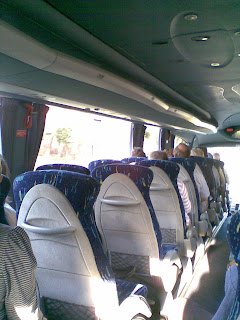
Here the group is boarding the coach for a day trip to Subiaco, where St Benedict lived. The day will include a tour of the monastery there and the celebration of Mass. We're not sure how well our mobile technology will work in this more remote area, so if there are no posts for a while you know why. Either way, there will be posts at some point later today.
This evening the group had Mass in a chapel in the Basilica of Santa Maria Maggiore - St Mary Major - which is one of the four major basilicas of Rome. There was also a brief visit to the church of Santa Prassede, famous for its mosaics, and the church of St Peter in Chains. Tomorrow there's a day trip to Subiaco, where St Benedict founded his first monastic community.
After the excitement of this morning's Papal Audience, the group had some free time. Canon Stephen and Fr Andrew went to visit two familiar faces at the North American College (NAC): Deacon Nolan Lowry and his fellow student Bill Brunner. Both Nolan and Bill have spent time on placement at the Cathedral. Here they are on the roof of the NAC, with a fine view of St Peter's behind.
The Audience has now finished and the Pope is greeting some of those present. Here some members of the group look out over the square, which is still packed as people wait to see the Holy Father leave. The Popemobile has just arrived, ready for the return journey!
A few moments ago Pope Benedict offered greetings to all the English speaking pilgrims present at the audience. As the Cathedral parish was amounced he looked towards the group and gave a wave. This is the view the pilgrims are seeing; the Pope is just a short distance away. As always, you can click on the image for a larger version. In a few moments the Holy Father will give a blessing, which he extends to family and friends at home.
The square is filling up, as it does every Wednesday. People are here from all parts of the world. Many have brought banners and flags, and groups are singing. Among those here today is Cardinal Keith O'Brien, Archbishop of St Andrews and Edinburgh. The Cardinal is well known to us in Lancaster, having visited the Cathedral twice in the last two years. 35 minutes to go until the Pope arrives!
The pilgrims have passed through all the security checks and have taken their seats ready for the audience. There's now quite a wait before the Pope arrives. You can watch the audience live on EWTN - Sky channel 589 or ewtn.com. Keep your ears open as the Cathedral group should be mentioned at some point. Keep your eyes open too - the group is sat right in front of the Basilica over to the right hand side.
This morning our pilgrims in Rome are heading for St Peter's Square, to see the Holy Father at his weekly general audience. It starts at 9.3Oam English time; there will be a further update on the blog on arrival at the square.
The main chapel of the English College has been undergoing a two-year restoration programme and reopened earlier this month. The result is stunning, and we plan to post some high quality images on return to England. Meanwhile here is a view looking down on the altar. Here Canon Stephen, who trained at this college, celebrated a Votive Mass of the college's martyrs earlier this afternoon. This evening some members of the group will visit the Trevi Fountain, and tomorrow morning we're off to see the Pope. Check the blog from 9.3Oam English time.
Our pilgrims are currently taking a look around the Venerable English College, the oldest British institution abroad. Founded in 1579, it continues to train priests for the English and Welsh dioceses. Our guide is Tony, a student for the Diocese of Shrewsbury.
This is the scene now in St Peter's Square. The group had an excellent tour of the Basilica this morning, followed by a chance to visit the crypt, where many of the Popes are buried. This afternoon there will be Mass in the English College, followed by a tour.
The group is fitted out with audio sets so that we can hear our guide properly. Let the tour commence!
The group of Cathedral pilgrims has just arrived at the Vatican, where they will have a tour of St Peter's Basilica. It's an impressive sight! Click on the picture for a larger version.
This evening the first Mass of the pilgrimage was celebrated in the church of Sts John and Paul, pictured. It took place in a side chapel which contains the body of St Paul of the Cross, founder of the Passionist order. It's been a long day and a quiet evening is ahead. Tomorrow brings a trip to the Vatican and Mass at the English College. Keep up to date on the blog as the trip progresses. In the meantime, don't forget that you can enlarge the pictures by clicking on the image.
The group has just had a tour of San Clemente, one of Rome's most important churches. It dates from the 12th century, but is built over the remains of a 4th century church and - beneath that - a temple of Mithras from the 1st century BC. Next the group will celebrate Mass in a nearby church.
Here's a view of the street just outside the hotel where the Cathedral group is staying. Everyone has arrived safely and had lunch. Next on the programme is a visit to the Basilica of San Clemente.
If you're reading this then our technology is working! Over the next few days we plan to provide several short posts each day giving updates from Rome. Our plane landed just before 1O:3Oam and the group is now heading for the hotel. More to follow later in the day.
 Tomorrow the Cathedral's 150th anniversary pilgrimage to Rome begins. It's a week long trip to the 'eternal city', and around 30 parishioners are travelling. It promises to be quite a week!
 After arrival tomorrow morning, there will be an afternoon visit to the Basilica of San Clemente then Mass in Rome's Cathedral Church (pictured here), the Basilica of St John Lateran.
 Not far from the hotel is the famous Colosseum; tomorrow's programme ends with an optional evening stroll to this impressive landmark.
 Tuesday morning sees a visit to the Vatican, for a guided tour of St Peter's Basilica. Afterwards pilgrims will be able to visit the crypt, containing the tombs of many popes, including Pope John Paul II; there will also be an opportunity to climb the dome for a spectacular view over the city. Mass on Tuesday will be celebrated at the Venerable English College, where Canon Stephen trained for the priesthood. The chapel at the college has recently been restored (more information here) and there is also a new exhibition about the English pilgrimage to Rome (find out more on a special website, here). The evening offers chance for a visit to the Trevi Fountain.
 One of the highlights of any trip to Rome is a chance to see the Holy Father, and the parish pilgrims will be attending the weekly Papal Audience in St Peter's Square on Wednesday morning. Pope Benedict will deliver an address and greet the various pilgrims who are present. You can watch the audience live on the Catholic TV channel EWTN (available in the UK on Sky Digital, channel 589, or watch online at www.ewtn.com). It starts at 9:30am (English time). In the afternoon there will be Mass at the 5th-century Basilica of St Mary Major and a visit to the church of Santa Prassede, which contains some famous 9th-century mosaics.
 On Thursday there's a day out to Subiaco, where St Benedict set up his first monastery. There will be a tour and Mass before a return to Rome and visit to the Basilica of the Holy Cross, which contains relics of the Passion.
 Friday brings opportunity for an early Mass at St Peter's Basilica, near to the tomb of our patron. After this there will be an opportunity for personal sightseeing, and a number from the group will visit the extensive Vatican Museums and the famous Sistine Chapel.
 On Saturday there's a morning excursion to the Basilica of St Paul Outside the Walls, which contains mosaics of all 265 popes. In the afternoon there's a visit to the Catacombs, where a vigil Mass for the feast of All Saints will be celebrated.
 These are just some of the highlights of the week; there will be much more to report, and no doubt we will see one or two familiar faces in the city. Everyone in the parish will be remembered in prayer during the pilgrimage, and our thoughts are especially with those who would like to come but - for whatever reason - are not able to do so. You can follow the pilgrimage on the blog: technology permitting, we hope to provide the blogging equivalent of an 'outside broadcast', with several posts each day during the week. If the technology lets us down there may be a break in posting, but - either way - there will be plenty of pictures and reports on our return. Meanwhile, don't forget that all Masses will take place in the Cathedral as normal; Vespers will also be celebrated on Sunday at the usual time. Confessions take place as usual on Saturday morning, and on demand before Mass on Saturday evening. There will be no Exposition on Thursday, but it will take place as usual on Saturday and Sunday. Cathedral House will be occupied throughout the visit, but there may not always be someone to answer the phone! If you need a priest in an emergency, try St Bernadette's (tel: 63000) or St Joseph's (tel: 32493). Normal service resumes shortly!
 Among the many items the Cathedral borrowed for the visit of St Thérèse were a number of votive candle stands. When they were removed from the Cathedral ready to be returned to their owners, they were briefly lined up along the main corridor in Cathedral House... right beneath the portraits of our former bishops. Lighting a candle before a statue or image of a saint is, of course, an act of devotion; there are (sadly!) no reports of any candles having been lit beneath the bishops' pictures. The stands were quickly moved on and are now back where they belong!
 Historians will no doubt look back on 2009 as one of the most significant years in the history of our Cathedral. If you're interested in the events of the past, don't forget that Billington's Blog continues to post all kinds of historical information and pictures. Over the last week or two we have seen everything from Cardinal Allen to the development of the Cathedral newsletter, from the Cathedral's pulpit to the 1945 football team. A great variety of posts are already online, and there's much more to come before the year is out. You can find Billington's Blog here.
 Earlier this week a new publication was launched by the Bishops' Conference. Designed for those who are interested in the priesthood, the book provides a description of a priest's life and vocation, alongside practical information about how to apply for the priesthood. It includes a foreword by Archbishop Vincent Nichols of Westminster and Cardinal Keith O'Brien, Archbishop of St Andrews and Edinburgh. The initial print run is 10,000 copies, and the publication will be available from every Catholic high school, university chaplaincy and diocese in the UK.
 Archbishop Nichols (centre) was at the launch of the book. The text - based on an earlier work by Bishop Michael Evans of East Anglia, has been revised by Fr Paul Embery, formerly national co-ordinator of the Vocations Service. Fr Paul (seen far right on the picture here) is now Chancellor of the Lancaster Diocese and Parish Priest of Holy Trinity and St George, Kendal. You can find out more about the new publication, which is called "The Catholic Priest - answering God's call", on the Bishops' Conference website, here.
 This picture of St Thérèse, from the materials the Cathedral produced for schools ahead of the visit of her relics, shows her performing a small act of service while in Carmel. Such acts are at the very heart of Thérèse's spirituality: she teaches not great gestures, but small, everyday acts of love - small kindnesses shown to others motivated by a love of Jesus Christ. This is the 'Little Way' of which Thérèse spoke.
 With this in mind, the Bishops' Conference of England and Wales proposes to us 'Little Way Week'. It began last Sunday (don't worry - you can join in late!) and is the first major initiative aimed at following up the visit. The basic idea is very simple: each day this week, perform one small act of kindness beyond what you would normally do; if anyone asks why you have done it, be prepared to explain something of the 'Little Way' to them. You can find out more about Little Way Week and see suggestions of how to take part on the Bishops' Conference website: click here to take a look.
 Last night the parish took over Lancaster's prestigious Grand Theatre for the evening, with the last of three dramas about our patron, St Peter, being held there. The event followed two earlier productions at the Cathedral (posts here, here and here) which explored St Peter's life and his contribution to the early Church.
 Parishioners gathered alongside others who had seen the event in the Grand Theatre's own publicity or on their website.
 The production centred on Peter's role as guardian of the gates of heaven. He waits next to the gates, and people whose earthly life had ended came to meet him and try to enter heaven. In the course of events we found out about their lives on earth - the good and the bad - and followed their progress. Would they get through?
 While the stage represented the gateway to heaven, the upper floor of the theatre represented heaven itself. A quartet of voices (there really are four - two are out of view in this picture!) represented the heavenly host, providing music in wonderful four-part harmony. Those who were allowed to pass the pearly gates also made their way upstairs.
 It was great to see many members of the parish involved in the production. This drama - and the two shows earlier in the year - were masterminded by Emma Rucastle, a local drama teacher. Emma has brought together a great group of volunteers to appear in the performances, and some people have been in all three shows.
 Dressed in their school uniforms - though a bit of a blur here! - are a number of children from the Cathedral Primary School, who also took part in the drama. There were also some members of the Cathedral's Cafe Club for young people.
 Here St Peter, on the stage, seeks advice from the Lord, who appears upstairs in the box. He's judging two difficult cases: an insincere politician and a wealthy celebrity, and is not too keen on either! One of the key messages of the production was that contrition is key: whatever our failings in life, if we are genuinely sorry we can always ask the Lord for forgiveness.
 Here some members of the cast prepare to take a bow at the end of the production. Despite some serious messages the show included a lot of humour and was greatly enjoyed by those present. We are very greatful to Ellie and to all at the Grand Theatre for their hospitality last night. The Grand Theatre (website here) is among those who are supporting events in the Cathedral's 150th anniversary year. You can find a full list of our 150th anniversary sponsors here.
 Last Sunday Pope Benedict canonised five new saints at St Peter's Basilica in Rome. While Pope John Paul II canonised a great many saints during his pontificate, the rate of canonisations has slowed under Pope Benedict. Our man in Rome sent us some pictures earlier this week.
 Here the Pope is speaking after the Canonisation Mass, delivering his usual Sunday Angelus address and blessing.
 Although Mass was celebrated inside the Basilica, a huge crowd also gathered outside, such was the number of people who wished to attend. Among those who were canonised were the priest known as 'Fr Damien', famous for his ministry to lepers on the Hawaiian island of Molokai in the 19th century. During his work he caught the disease, and died on the island in 1889.
 Also canonised was Jeanne Jugan (Sister Marie de la Croix), who founded the Little Sisters of the Poor. The order has a house in our Diocese in Preston, and members of the community travelled to Rome to be present at the canonisation. The order cares for the elderly and is currently active in over 30 countries worldwide.
 At the solemn canonisation of the saints, the Holy Father declared: "By the authority of our Lord Jesus Christ, the Blessed Apostles Peter and Paul and by Our own authority, after mature deliberation and having called once again for Divine help and having listened to the advice of many of our brothers in the Episcopate, we declare and define to be Saints the Blesseds Sigmund Felix Felinski, Francisco Coll y Guitart, Joseph Damian De Veuster, Rafael Arnaiz Baron and Marie of the Cross Jugan and we write them in the Catalogue of the Saints." A week tomorrow our parish pilgrimage to Rome begins, and - technology permitting - we will provide extensive coverage during the pilgrimage here on the Cathedral blog.